INPUT ↔ ↔ ↔ REPRESENTATION
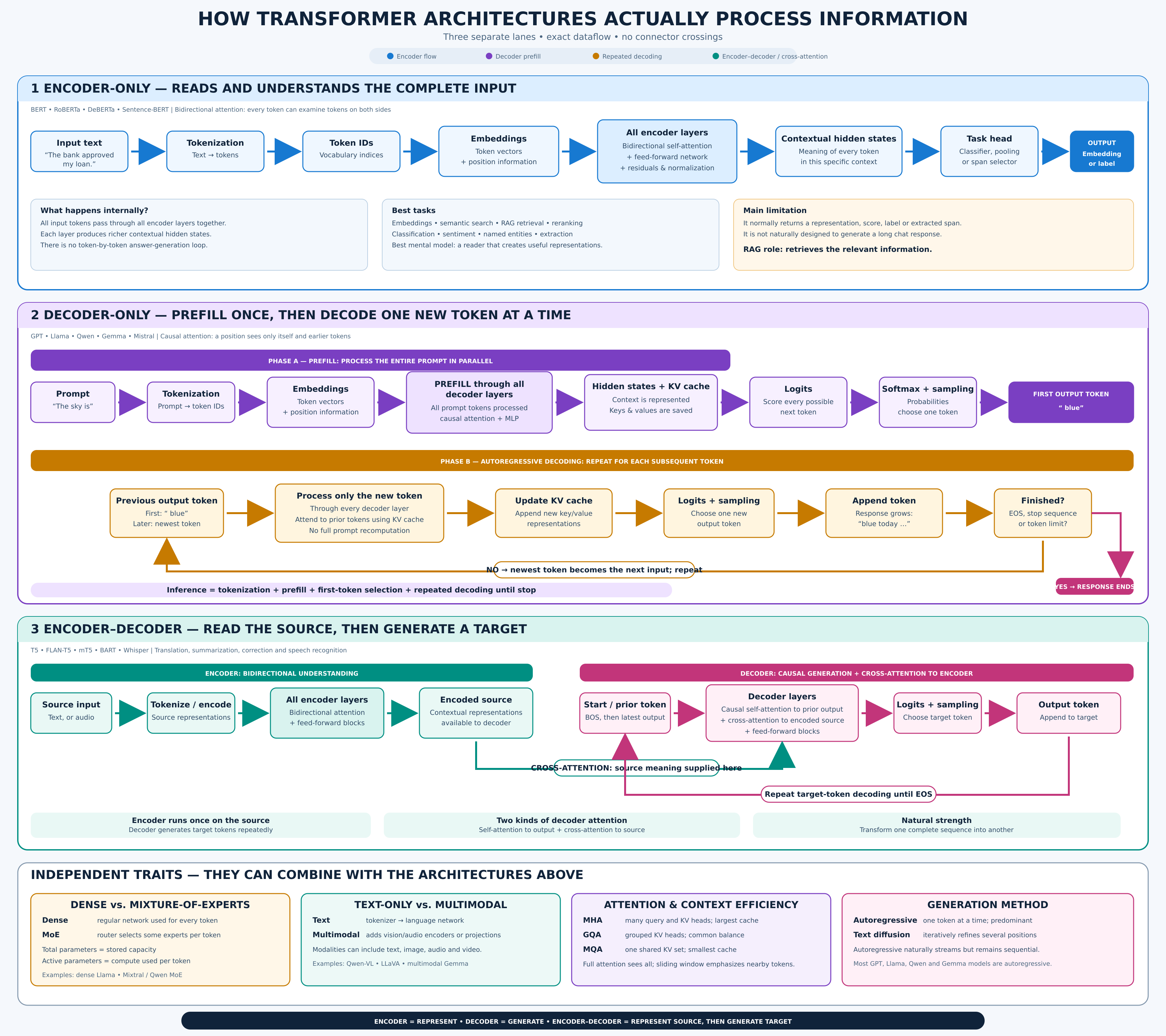
Encoder-only
Looks both left and right. Best at understanding.
QUICK RECOLLECTION REFERENCE · AUGUST 2026
A compact map from text → tokens → tensors → Transformer layers → output, and from architecture → parameters → file format → framework → inference engine → provider.
THE CORE LOOP
ENCODING
Encoding is not encryption or instant “understanding.” It is the transformations turning raw input into increasingly context-aware tensors. In decoder-only LLMs, this occurs during prefill.
BLUEPRINTS
Looks both left and right. Best at understanding.
Looks backward. Best at open-ended generation.
Reads a source, then generates a target.
| Architecture / trait | Information flow | Where it shines | Examples | Remember |
|---|---|---|---|---|
| Encoder-only | Whole input, bidirectionally | Understanding, classification, embeddings | BERT, RoBERTa, DeBERTa | Usually not long-form generation |
| Decoder-only | Causal; predicts next token | Chat, writing, code, agents | GPT, Claude, Llama, Qwen, Mistral, DeepSeek | Dominant general-purpose LLM |
| Encoder–decoder | Encoder reads; decoder writes | Translation, summarization, transformations | T5, FLAN-T5, BART | Distinct source and target sequences |
| Mixture of Experts | Router activates select expert FFNs | More capacity per active compute | Mixtral, DeepSeek-V3, Qwen3-MoE, Llama 4 | A Transformer routing design |
| Multimodal | Adds modality encoders or unified tokens | Images, audio, video and text | GPT-4o, Gemini, Claude, Gemma 3n | Capability—not one architecture |
| Diffusion / parallel text | Iteratively denoises positions | Experimental parallel generation | LLaDA and research systems | Not the usual next-token loop |
No universal “best” model: task, data, latency, context, hardware, license and cost determine the best fit. Benchmark on your actual workload.
MODEL SPECS
Learned-number count—not layers. More capacity can help, but training and design matter.
Repeated Transformer blocks. Every token passes through all of them.
Maximum working token sequence; longer context increases cache and compute.
Width of each token’s internal vector.
Parallel relevance subspaces; GQA/MQA share KV heads to save memory.
Number precision. Fewer bits shrink memory, sometimes with quality loss.
Dense activates all weights; MoE routes tokens through selected experts.
Decode speed; time-to-first-token is strongly affected by prefill.
DO NOT MIX THESE UP
Transformer · encoder · decoder · MoE · multimodal
blueprintPyTorch · JAX · TensorFlow/Keras · MLX
tensor toolkitSafeTensors · PyTorch checkpoint · ONNX · GGUF · MLX
stored learningTransformers · vLLM · llama.cpp · TensorRT-LLM · ONNX Runtime
execution runtimeCPU · GPU · Apple silicon · TPU · cloud API
compute + operations| Framework | Best for | Why Python is not the bottleneck | Where it shines |
|---|---|---|---|
| PyTorch | Research, training, fine-tuning, flexible inference | Python orchestrates; compiled C++/CUDA/Triton kernels do heavy math | Default for experimentation and Hugging Face |
| JAX | Accelerator-scale research | XLA compilation + functional transformations | TPUs and highly vectorized research |
| TensorFlow / Keras | Established production ML | Graph/eager execution with compiled kernels | Mature enterprise/deployment ecosystem |
| ONNX + ONNX Runtime | Portable inference and cross-framework deployment | ONNX stores the computation graph; ONNX Runtime executes it with optimized hardware backends | Moving trained models between PyTorch/TensorFlow and server, desktop, browser or edge |
| MLX | Apple-silicon work | Lazy arrays + unified memory | Local Mac fine-tuning and inference |
| Format | Contains | Main purpose | Preferred situation | Important nuance |
|---|---|---|---|---|
| SafeTensors | Weights only | Safe, fast checkpoint | Training, fine-tuning, Transformers inference | No arbitrary pickle execution |
| PyTorch .bin/.pt/.pth | Weights or Python objects | General/legacy serialization | Older checkpoints and research code | Supported—not universally deprecated; pickle can be unsafe |
| GGUF | Quantized weights + metadata | Portable local inference | llama.cpp ecosystem; CPU/GPU local use | Not PyTorch-native training format |
| ONNX | Portable graph + weights | Framework-neutral deployment | ONNX Runtime: server, browser, edge | Operator export support varies |
| TensorRT engine | Compiled optimized graph | Maximum NVIDIA performance | Specific production NVIDIA stack | Fast but less portable |
| MLX | Apple-oriented arrays/weights | Unified-memory execution | Apple-silicon training and inference | macOS-focused ecosystem |
| Engine | Typical input | Hardware | Where it shines |
|---|---|---|---|
| llama.cpp | GGUF | CPU, CUDA, Metal, Vulkan | Local/offline and quantized models |
| vLLM | Usually SafeTensors/Hugging Face | GPU servers | High throughput, continuous batching, PagedAttention |
| TensorRT-LLM | Converted/compiled artifacts | NVIDIA GPUs | Maximum optimized production performance |
| Transformers + PyTorch | SafeTensors / PyTorch | CPU/GPU/accelerators | Flexible reference inference and debugging |
| ONNX Runtime | ONNX | CPU, GPU, NPU, browser/edge | Portable deployment |
| MLX-LM | MLX weights | Apple silicon | Convenient Mac inference/fine-tuning |
| Ollama / LM Studio | Often GGUF | Desktop/local | Friendly model management and chat; wrappers, not formats |
CHANGE KNOWLEDGE OR SUPPLY KNOWLEDGE?
Update most or all parameters. Maximum control, compute and storage.
dataset → loss → backprop → updated baseFreeze the base and train small low-rank adapters. QLoRA holds a quantized base while training.
base + small adapter → specialized behaviorRetrieve current/private information at inference. No weight update.
question → retrieve → augmented prompt → answerHOSTED INFERENCE
You send an API request. It handles model loading, GPUs, the engine, batching, autoscaling, caching, security, observability and billing. Model creator, model host and provider can be different companies.
FAMILY TREE
Simplified lineage. Arrows show family progression; shared Transformer ancestry does not imply inherited proprietary weights.
Updated from official family announcements through August 2026.
FAST LOOKUP
THE 20-SECOND RECALL
HIGH-RESOLUTION MEMORY MAP